
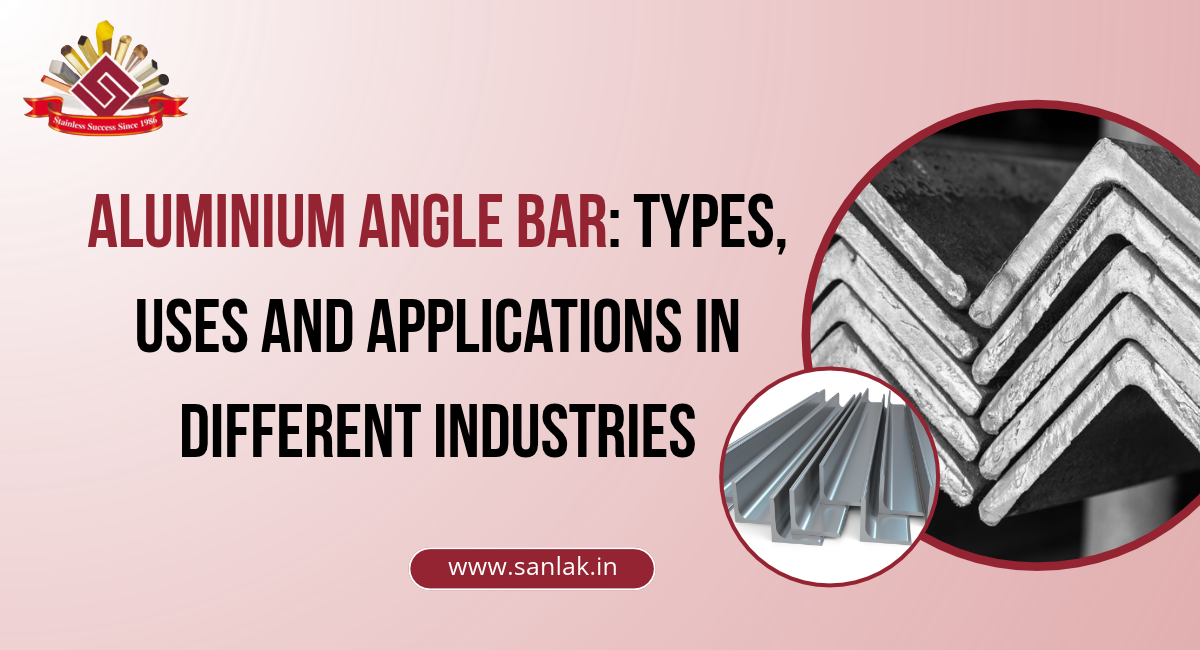
Aluminium Angle Bar: Types, Uses and Applications in Different Industries
Introduction
The application of aluminium angle bars is widespread in the construction, manufacturing, fabricating and engineering sectors because of the features of these angle bars, which include lightness, strength, corrosion resistance and workability. Aluminium angle bars are ideal for various applications such as structural frames, brackets, parts of machines and furniture structures among others. The selection of the right aluminium angle bar is essential for companies to achieve their goals. For companies purchasing aluminium materials, understanding the alloy grade, dimensions, thickness, surface finish and intended application is important. Aluminium angle bar types must be selected based on project specifications, load requirements and environmental conditions. Santhana Lakshmi Metals (Sanlak) offers a range of metal products to support diverse industrial and commercial needs.
Table of Contents
What Is an Aluminium Angle Bar?
Different Types of Aluminium Angle Bars
Uses and Applications of Aluminium in Different Industries
Advantages of Using Aluminium Angle Bars
How to Choose the Right Aluminium Angle Bar for Your Application?
Conclusion
FAQs
What Is an Aluminium Angle Bar?
An aluminium angle bar is a metal extrusion whose cross-section is an L-shape that comprises two limbs usually meeting each other at a 90-degree angle. It is manufactured from aluminium alloys and is widely applied in situations where structural support, edge protection and framework construction is required. The angle profiles can be found in various sizes of limbs lengths, thicknesses, and aluminium grades.
Lighter weight makes their handling, cutting, drilling, and installation more manageable than heavy metal alternatives. Aluminium angle bars can be made through the extrusion process whereby molten aluminium is forced into a die that forms the desired shape of the bar. This ensures that manufacturers can make angle bars of uniform shapes and sizes for different uses.
Different Types of Aluminium Angle Bars
There exist various types of aluminium angles depending on the shape, size, surface finish and uses of the materials. Different types have their distinct advantages in building and fabricating activities. Knowledge of these differences will help buyers purchase the appropriate aluminium angle for their projects.
1. Equal Aluminium Angle Bars
Equal aluminium angle bars have two equal legs at a 90-degree angle, making an L-shape. The symmetry of the shape makes them ideal for applications that require balanced support and uniform dimensions. The uses of these aluminium angle bars include structures, protective covers of machinery, shelf systems, furniture frames and reinforcement at corners. Their light weight also makes them easier to cut and drill.
2. Asymmetrical Aluminium Angle Bars
In the case of unequal aluminium angle bars, both of the legs have different lengths, which makes them an excellent choice for projects that demand asymmetrical support or fitting requirements. They provide greater flexibility in structural designs where equal leg dimensions may not be suitable. Some of the uses of these profiles include manufacturing of industrial machinery, construction framework, support brackets, and many more. Choosing the correct dimension of the legs helps to get the desired structural support.
3. Anodized Aluminium Angle Bars
The surface treatment done on the anodized aluminum angle bars is electrochemical in nature and results in the formation of an increased thickness of oxide coating on the aluminium surface. This helps to improve corrosion resistance, surface durability, and aesthetics. The aluminium angles find applications in buildings, architecture, outdoor projects, etc., due to the need for surface protection. Anodizing is also available in different colors, depending on the required finish and product specifications.
4. Structural Aluminium Angle Bars
Structural aluminium angle bars are used in applications where strong support and stability are needed. The effectiveness of structural angle bars depends on the grade of aluminium alloy used, its dimension and thickness. They are mostly used in industrial structures, machine structures, construction structures, manufacturing structures, and equipment assembly. Choosing the correct grade and dimension is is important to ensure the angle bar can withstand the expected loads and operating conditions.
The manufacturing procedure is equally important in defining the dimensional accuracy, strength, and surface finish of aluminium angle bars. Read our blog How Aluminium Angle Bars Are Manufactured and Extruded? to understand how these profiles are produced.
Uses and Applications of Aluminium in Different Industries
Due to their versatility, aluminium angle bars find application in various industries. They offer benefits such as light weight, resistance to corrosion and are easy to fabricate.
Construction Industry: Used in building frames, reinforcing corners, making windows and doors, making partitions, and architecture finishing.
Automotive and Transportation Industry: In making components of cars, interior frames, support brackets, and transport equipment.
Electrical and Electronics Industry: In making frames of electrical panels, enclosures of equipment, mounting supports, and electronic assembly frames.
Manufacture of Furniture: Used for making shelves, racks, display stands, cabinet frames, and furniture components.
Industrial Fabrication and Manufacturing: Used for making machines frames, conveyor support frames, workstation structure frames and protective enclosures.
Renewable Energy and Solar Energy Industry: Used for making mounting frames and equipment supports.
Aluminium angle bars can also be cut, drilled and fabricated to meet specific industrial requirements. Check out our blog Practical Role of Aluminium Angle Bars Across Industries to learn more about their applications across different sectors.
Advantages of Using Aluminium Angle Bars
There are many benefits offered by aluminium angle bars, which is why these are used extensively in industry and commerce applications.
Light Weight: Aluminium has lesser weight than steel; thus, angle bars are easy to transport and fit together as well as making the structures lightweight.
Resistance to Corrosion: Aluminium develops an oxide layer that protects the metal from corrosion.
Good Strength-to-Weight Ratio: The ratio of strength and weight of aluminium angle bars is very useful in many structural and fabrication uses.
Easy Fabrication and Installation: They are easy to cut, drill, machine, and produce to meet the exact requirements of a project.
Recyclability: The aluminium is recyclable without changing any of its basic characteristics.
Versatile Surface Finishes: Mill finish and anodized finish are two types of surface finishes available.
Read our blog Top Reasons to Use Aluminium Angle Bars in Your Projects to explore these benefits in more detail.
How to Choose the Right Aluminium Angle Bar for Your Application?
Selecting a reliable aluminium angle bar supplier will be vital in sourcing products that are ideal for your project. The supplier must provide you with high-quality products with well-defined specifications and effective communication. In selecting an aluminium angle bar supplier, you need to look at the different grades of aluminium angle bars, their sizes, thickness, surface finish, and quality. It is also important to check bulk-order availability, delivery timelines, customisation options and transparent pricing to ensure the materials meet your industrial requirements.
Working with an experienced supplier can make it easier to identify suitable products for different applications. Santhana Lakshmi Metals (Sanlak) provides a range of aluminium products suitable for industrial, construction, manufacturing and fabrication requirements. Its aluminium product range includes aluminium angle bars, sheets, coils, roofing sheets and pattern sheets, with options to support different project specifications and applications.
Conclusion
Aluminium angle bars are very flexible materials which find wide use in many industries including building, manufacturing, and fabrication. The light weight, resistance to corrosion, high strength-to-weight ratio, and fabricability of these materials make them well suited for many structural and commercial needs. Understanding the types, standards, uses, and advantages of aluminium angle bars helps businesses select the right material for their projects. Santhana Lakshmi Metals (Sanlak) offers a range of aluminium products, including aluminium angle bars, to meet diverse industrial and commercial requirements. Get in Touch and discuss your requirements and find suitable aluminium products for your business.
FAQs
1. What is an aluminium angle bar?
An aluminium angle bar is an L shaped piece of metal, used for structural purposes and fabrications.
2. What are the different types of aluminium angle bars?
The types of aluminium angles are equal, unequal, anodized, and structural aluminium angles.
3. What are aluminium angle bars used for?
They are used for construction, furniture, automotive, electrical, and industrial fabrications.
4. What is the difference between equal and unequal aluminium angles?
In equal angles, the lengths of legs are equal, and in unequal angles, the lengths of legs are not equal.
5. What aluminium products does Sanlak offer?
Sanlak offers aluminium angle bars, unequal angles, sheets, coils, roofing sheets and pattern sheets.
6. Are aluminium angle bars corrosion-resistant?
Yes, the natural process of developing an oxide layer on aluminium makes it corrosion resistant.
7. List some applications of aluminium angle bars.
Some common applications are frameworks, brackets, equipment support, shelves, etc.
8. What determines the cost of aluminium angle bars?
The cost varies depending on alloy type, dimension, thickness, number, surface finish, and market prices.
9. How do aluminium angle bars differ from steel angle bars?
Steel angle bars have high tensile strength, whereas aluminium angle bars are lightweight and corrosion resistant.
10. Why choose Sanlak for aluminium angle bars?
Sanlak provides aluminium products with different specifications to support industrial and commercial requirements.