
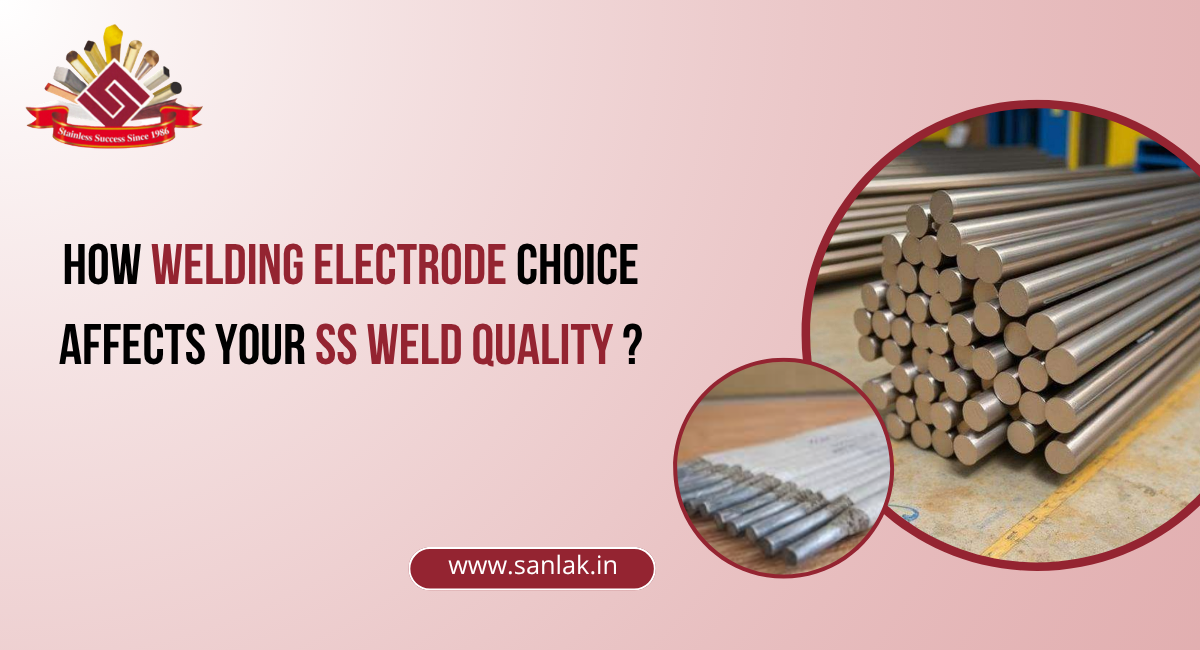
How Welding Electrode Choice Affects Your SS Weld Quality ?
Introduction
Selecting the correct welding electrode is not just a technical formality - it is the deciding factor between a durable, corrosion-resistant joint and a brittle, failing weld. For professionals working with stainless steel (SS), the electrode choice directly influences SS weld quality, structural integrity, and long-term project costs.
At Sanlak, we have seen countless weld failures traced back to one root cause: an mismatched electrode. In this guide, we will break down how electrode selection impacts your results and how to choose wisely. For a complete range of premium options, explore Sanlak's stainless steel electrode collection.
Table of Contents
- Why Electrode Chemistry Matters for SS Welding ?
- Key Factors Affecting SS Weld Quality
- Common Electrode Mistakes and Their Consequences
- Electrode Selection Guide (Tabulated)
- FAQs
- Final Thoughts & Call to Action
Why Electrode Chemistry Matters for SS Welding ?
Stainless steel derives its corrosion resistance from chromium and nickel. When you weld, the electrode must deposit a filler metal with a similar or superior alloy content. If you use a mild steel electrode on SS, chromium carbide precipitation occurs, leading to intergranular corrosion. This is why SS weld quality begins at the electrode specification.
- 308L electrodes are ideal for welding 304 stainless steel.
- 316L electrodes add molybdenum for pitting resistance (ideal for marine environments).
- 309L electrodes work best for joining stainless to carbon steel.
Using the wrong electrode creates weak, rust-prone welds that fail under stress or chemical exposure.
Key Factors Affecting SS Weld Quality :
1. Alloy Composition Matching
The electrode’s chemical makeup must match or overmatch the base metal. For example, welding 316 SS with a 308 electrode reduces corrosion resistance dramatically.
2. Low Carbon Content (L Grades)
Electrodes with a “L” designation (e.g., 308L) contain less than 0.03% carbon. This prevents carbide precipitation, which maintains SS weld quality in high-temperature service.
3. Ferrite Number Control
Too much ferrite reduces toughness; too little invites hot cracking. Quality electrodes balance the ferrite-austenite ratio.
4. Moisture Resistance
Low-hydrogen electrodes (like the E308L-16) reduce hydrogen-induced cracking. Sanlak recommends storing electrodes in a rod oven to preserve their low-hydrogen properties.
Common Electrode Mistakes and Their Consequences
Mistake | Consequence on SS Weld Quality |
Using 7018 on 304 SS | Rapid rusting, complete corrosion failure within weeks |
Ignoring “L” grade for thin sections | Weld decay, cracking at heat-affected zone (HAZ) |
Mixing different brand electrodes | Inconsistent arc stability, porosity |
Using old, moisture-exposed rods | Hydrogen cracking, poor slag removal |
Checklist before welding:
- Verify base metal grade (304, 316, 310, etc.)
- Match electrode to base metal chemistry
- Check for “L” designation if corrosion is a concern
- Use Sanlak approved low-hydrogen electrodes for critical joints
Electrode Selection Guide :
Base Metal (SS Grade) | Recommended Electrode | Key Property Maintained |
304 / 304L | 308L | General corrosion resistance |
316 / 316L | 316L | Pitting & crevice resistance |
310 / 310S | 310 | High-temperature oxidation resistance |
304 to Carbon Steel | 309L | Dissimilar metal bonding |
410 (Martensitic) | 410 or 309L | Hardness & impact strength |
How Electrode Diameter & Amperage Influence Weld Quality
Many welders overlook diameter choice. A 3.2mm electrode on thin-gauge SS (1.5mm) will burn through, causing sugaring on the backside. Conversely, a 2.0mm electrode on 10mm plate leads to lack of fusion. Always match electrode diameter to:
- Material thickness
- Joint design (butt, fillet, lap)
- Welding position (flat, vertical, overhead)
Sanlak stocks a full range of diameters (1.6mm to 5.0mm) for precision control over your SS weld quality.
Frequently Asked Questions :
1. Can I weld stainless steel with a normal mild steel electrode?
No, mild steel electrodes lack chromium and nickel, causing immediate rust and weld failure.
2. What does the “L” stand for in SS welding electrodes like 308L?
“L” means low carbon (below 0.03%) to prevent intergranular corrosion.
3. Which electrode is best for welding 316 stainless steel in saltwater environments?
Use 316L electrode for maximum pitting and crevice corrosion resistance.
4. Why does my SS weld show blackish slag and porosity?
That indicates moisture in the electrode or incorrect polarity; use fresh, low-hydrogen rods from Sanlak.
5. How do I store stainless steel electrodes properly?
Keep them in a heated rod oven at 120–150°C (250–300°F) or in sealed moisture-proof containers.
Advanced Tip: Back Purging & Electrode Synergy
Even the best electrode cannot fix poor back purging. For austenitic stainless steels, use argon back purging alongside a low-carbon electrode. The combination prevents sugaring (oxide formation on the root side) and preserves SS weld quality from root to cap.
Conclusion
Your welding electrode is not just a consumable it is the backbone of every strong, corrosion-resistant stainless steel joint. From matching alloy chemistry to controlling carbon content and moisture, every decision impacts the final weld. By following the guidelines above and using reliable products from Sanlak, you can eliminate costly rework and ensure long-lasting performance. For more expert advice, visit our blog on how to choose the right electrode for stainless steel welding.
Ready to upgrade your SS welding results?
Contact Sanlak today for expert technical support and premium stainless steel electrodes. Request a Quote – Your next perfect weld starts here.